This will be of interest to a fairly niche (but incredibly tasteful and intelligent) audience of theatre nerds.
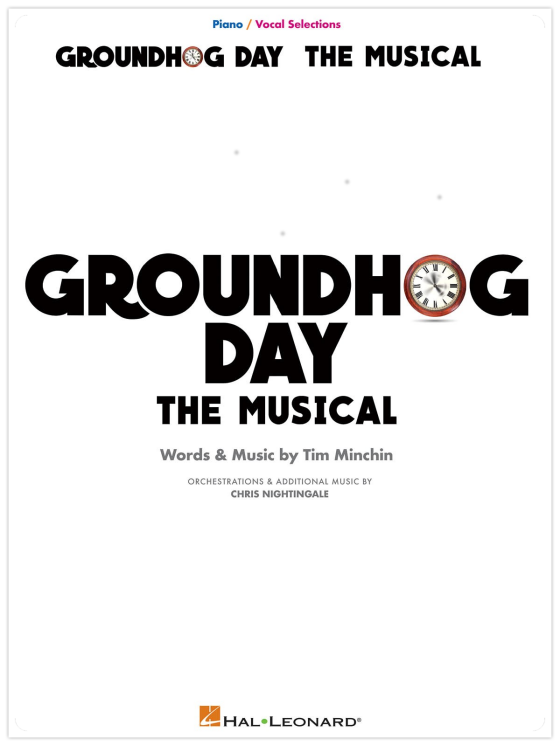
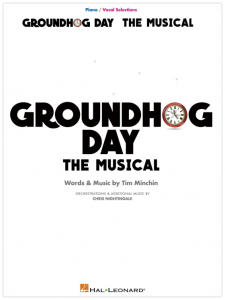
Hal Leonard have published a pretty damn comprehensive Groundhog Day songbook, which you can buy here.
At the front of the book is a bit of an essay I wrote reflecting on the musical and existential themes in the score, and I thought I’d publish it here for you to read! It’s kind of rambling (in a charming way, I hope), and I think it might be meaningful to those of you who loved the musical, and to anyone interested in the craft of musical story-telling. There’s also a second little essay about the unenviable job of transcribing my work, by the brilliant Laurie Perkins. I’ll pop that down the bottom.
By the way, I think the physical book is a thing of beauty and a lovely souvenir, even if you’re not a player. (Note: there are chords for lazy buggers like me who can’t read dots!)
Enjoy.
xTim
FOREWORD
Writing this musical with Danny Rubin, Matthew Warchus and Chris Nightingale was a joyous, existential adventure. There was so much that made my brain fizz when I first started to think about how we might put Groundhog Day on a stage.
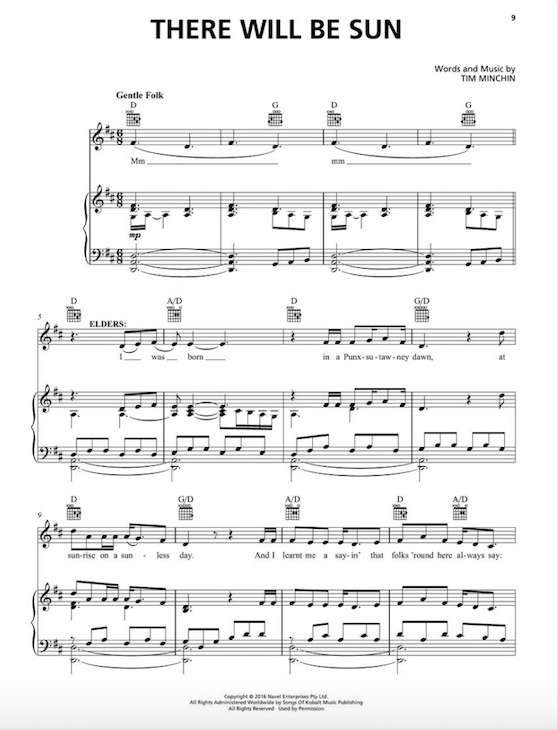
First, I was inspired by the simple, poetic idea of a life being reflected in a day. Our musical leans on this metaphor, opening in the pre-dawn with a song which itself starts with a birth. The idea of being born at “sunrise on a sunless day” suggests a dark day, a portent of the struggle we’re about to witness. But in that opening song, there is already an answer for Phil Connors, had he the wisdom to listen. The lyrics, like the town itself, are simple and pretty and folksy, but remind us that human happiness requires a level of acquiescence, an understanding that we are not all-powerful, and that despite our desire to “will the clouds away,” only time will reveal the sun.
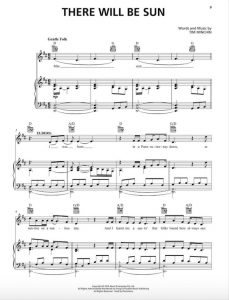
“There Will Be Sun” also immediately begins to play with ideas of circularity—musically, not just lyrically. The harmonic movement of the chorus is built on a simple climb up the major scale, resolving, like a day, in the same place it began.
In western music, an octave has twelve semitones, like the twelve hours of a clock. I obsessed over exploiting this coincidence, eventually finding expression for it in “Philanthropy” (an instrumental not included in this book). I also played with the idea of infinity in the musical’s main theme which is based, you’ll notice, on the harmonic movement of “Hope”, and is designed to give one the sense that it might just move ever upwards. This theme begins the “Overture” and recurs at the other end of the show, in the resolution of “Seeing You”: a musical sunrise and sunset.
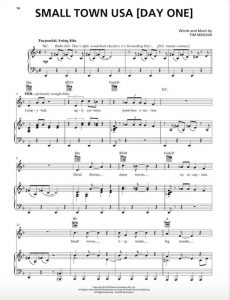
Not only is a life like a day, it is also—as Shakespeare among others pointed out—like a play. Which is convenient. Throughout the piece we flirt with the idea that Phil Connors is not only a man trapped in his life, and not only a man who is subsequently trapped in a day, but he’s also a player who is trapped in a play. And of all things, he’s trapped in a bloody musical! The townspeople of Punxsutawney are initially a rather grating musical-theatre chorus, asserting their relentless positivity in a repetitive, chintzy refrain: “Punxsutawney is a little town with a heart as big as any small town in the USA,” they squawk, to Phil’s grimacing chagrin. On this level, Phil’s journey is to find the beauty in the ‘musical of his life.’ (We were careful not to lean too hard on this meta-aspect, but I love that it shimmers away in the background. There are lyrics that allow you to think about the piece in this way, should you want to go searching!)
Another conceptual foundation of this score was the idea that the whole piece should echo the way our musical tastes change as we travel through our lifetimes, maturing with experience. As Phil Connors lives through the thousands of repetitions of his day-from-hell (or, metaphorically, as he lives through the various life-phases towards wisdom and eventual release), he undergoes trials which alter his emotional state. As a result, I let the style of music travel with him.
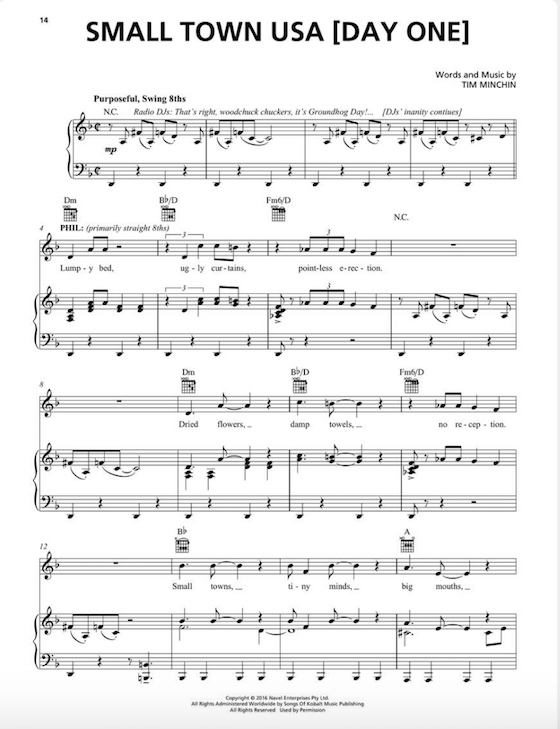
His opening number has a lyrical, melodic and rhythmic complexity that speaks to his urbane arrogance. His song is cynical and competitive, the melody angular and the lyrics complex, with barely a breath to allow space for the world to get a word in. The cheery town has to crash in with a frickin’ marching band to even have a hope of penetrating his egotism.
Then, when he finally realizes he’s genuinely trapped, we are suddenly thrust into that much underutilized musical genre: Telephone Hold Music. “Stuck” is suddenly finding yourself in purgatory: a twee, ’80s-keyboard-drum-machine Rumba that never resolves to the tonic. We are musically “Stuck” in a seemingly perpetual, cheesy-dentist-waiting-room loop, while our various quacks and vets offer useless solutions.
Phil’s subsequent booze-fueled anarchic phase is represented by the fast and furious drunken Bluegrass of “Nobody Cares,” while his sexually exploitative phase (“Philandering”, an instrumental not included in this book) draws musically from the trope of ’70s slap-bass, soft-porn funk!
Rita’s state of mind is also reflected in stylistic choices: “One Day” has the hopeful octave jump of “Over the Rainbow,” before it quickly becomes more bluesily cynical. (I always thought “blues” needed an adverb… now it does.)
When, at the top of Act II, Phil decides to end it all for both himself and his beaver-ish namesake, we fall towards shameless teen-angst-rock. This is a dark time in poor Phil’s life, and as his lyric mocks the very notion of “Hope,” our score takes an ironic jab at his melodramatic self-loathing. (Hopefully it works both ironically and un-ironically… after all, this was a character originally made famous by an actor who has managed to have his ironic cake and sincerely eat it too for decades!)
When Phil finally has no hope left at all (not even of successfully ending his life), sitting in the snow in a post-suicidal, nihilistic stupor, he finally tells Rita the truth about his love for her. It is the first time we have seen him be truly honest, the first time he isn’t motivated by selfishness. For that reason, “Everything About You” is musically honest, introducing the simple chord movement that later develops into “Seeing You.” (For lyrics nerds, note that he asserts that he knows everything in this song, and that he knows nothing in “Seeing You.” Wisdom is often said to come with an acceptance of your ignorance as well as your powerlessness.)
Rita pulls Phil from the pit of despair with an uplifting, innocent pop number that exploits the most utilized chord progression of all time. (Check out The Axis of Awesome’s “Four Chord Song” if you don’t know what I’m talking about!) It explores the old lament, “If I had my time again…” from a new angle: what if you literally could live your life over? What mistakes would you rectify? What missed opportunities would you grab? Of course, Rita’s natural optimism and kindness forces Phil to think a lot about his historically cynical, exploitative choices.
So Phil, taking Rita’s advice, starts to try to use his time for good. He begins to learn the piano (repetition, repetition, repetition) and, as the endless months of Groundhog Days roll by, he begins to become a master of his little universe. But just as he’s starting to find some peace in helping others and in self-improvement, he slips into despair again when he realizes he can’t save the life of Old Jensen, a homeless man he’s come to care for.
Enter Ned Ryerson. Previously the most annoying of the gratingly-annoying townspeople, he reveals himself to hold great wisdom born of great grief. “Night Will Come” exploits the same harmonic movement as “Hope,” but keeps it a little bit more in the minor mode. It still has that sense of circularity, and thematically it is related to the simple truth of “There Will Be Sun,” leaning again on the central life-as-a-day metaphor. But Ned’s song is not about patiently waiting for the sun to come out; it’s about acknowledging the inevitability of its going down. To really love life, he seems to tell us, you have to face the inevitability of death.
And so Phil enters a phase of his life in which he seeks meaning in virtuosity. His days are perfectly timed, impossibly intricate, and dedicated to helping others… and becoming a masterful musician. We tried to represent this in music, with the masterful Chris Nightingale helping me turn my flamboyant idiocy into a brilliantly orchestrated and deeply complex instrumental score. If you’ve bought this songbook, you’ve probably already got the album—thanks!—so you don’t need me to tell you how good Nightingale is.
But Phil has one more step to take. And I, musically, needed to land somewhere peaceful, authentic and centered. Around the time I was writing this score, I was listening to a lot of fantastic, rootsy Americana, and although I can’t pretend to be an artist with that heritage, I wanted to let myself be influenced by it. And, given this is a story about a man who begins with utter contempt for small-town rural America, it made sense to me that when he finally found true peace—when he finally realized that this place, this day, this life was enough—that it should sound a little like rural America. Or at least, that this urban Australian composer should let Americana have its influence.
“Seeing You” tries to bring it all together. It is the natural conclusion of the musical journey. It lands—hopefully not too heavily —on the central idea that Mr. Rubin buried in his amazing film script: happiness requires that you change the way you see the world, rather than constantly aspiring to materially alter it. And it ties up our metaphorical loose ends: the song is about his life journey, but when he sings “was it really only yesterday,” and refers to his suicidal phase as a “storm [that] overwhelmed me sometime late this morning,” he is speaking of life as a day. The lyrics even play with the notion that he is an actor stuck in a long-running musical: “I’ve spent a lifetime seeking signs, reading lines…” although, rather too trickily I suppose, these words also refer to his job as a meteorologist. A meteorologist is, of course, someone who spends their life trying to predict what is going to happen tomorrow.
In the middle of “Seeing You” is a huge breath of silence. If we’ve all done our job, the audience, like Phil, will sit happily in the beauty of the space. In inspirational, fridge-magnet terms, Phil has learned to live in the moment.
Danny Rubin is a brilliant, lovely man, who had a brilliant, lovely idea. And, man, we had fun making it into a musical.
And I dearly hope you have fun playing these selections.
Thanks for reading my ramblings. Thanks for caring about our piece.
Love and peace,
Tim
Fall, 2019
“As I say, it’s a little complex”—A PERFORMANCE NOTE
On a first approach to Tim’s music, a performer (and certainly transcriber) can be hit with a rhythmic curveball when tackling a sung line. Part of the individuality—and genius—of this writing is that many phrases do not line up with the meter of the accompaniment and in fact almost defy notation in their stresses and cross-rhythms. Those characters with their own set of rules, often at odds with everyone around them, now seem to have their own set of rhythmic rules. Think of Matilda and Miss Trunchbull’s “persistently resisting this anarchistic mischiefin’”—15 syllables effortlessly in the space of 16. And this brilliant disregard for standard notation is here at its fruitiest in Groundhog Day.
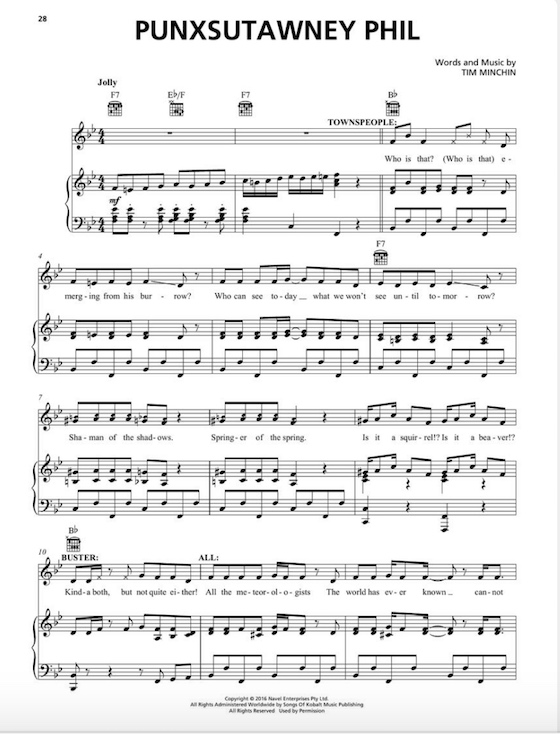
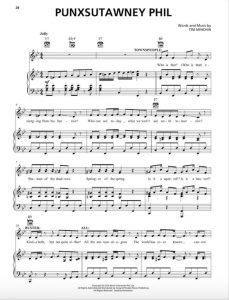
Tim highlights in his foreword the purposeful complexity of Phil’s music in “Small Town USA [Day One].” Just listen, for example, how the primarily straight-8th melodies in this number sit against primarily swung accompaniments—musically strengthening the defiance of Phil to fit in with the Punxsutawney locals. But whereas songs like “Punxsutawney Phil” and “If I Had My Time Again” are not too complex to notate, plenty of other stuff pushes the boundaries. “These endless first dates, that start with her hating me,” fits yet doesn’t really fit over Rita singing “One day, some day, my prince may come,” as at this point these two characters are dramatically poles apart. Some cool cross-rhythms slot in nicely—“You have Satan within you, we must exorcise your demons,” or “But for whose sake am I making all this effing effort for”—but some may stump, if you score-read them too literally—“An ever-lasting farcical disaster. You play your part, you march the march, you don’t complain.” And it’s not just Phil. Why all those combinations of triplets, dotted notes, and quintuplets in Rita’s diary entries? The reality, the trick to it all is, of course, straightforward: the rhythms of these moments are much closer to speech patterns than often encountered in a book musical. These snippets of over-precise notation are almost self-contradicting in fact, as they’re arguably more an indication of the melody and amount of time taken in which to sing those lines. It is more the intention of the character in that scene which will likely inform the speed and meter. Find the actor’s natural speech pattern and that’s probably how best to sing it. No wonder Tim left it to someone else to write this stuff down…
Laurie Perkins, transcription-chap of all things Minchin/Nightingale.